War as Trump’s family business
How defense policy turned into billion-dollar opportunities for those close to the president
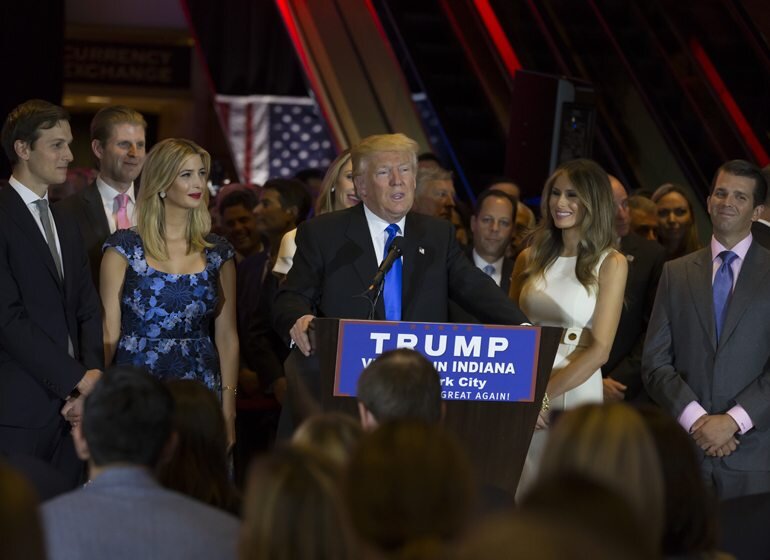
TEHRAN - Since Donald Trump returned to the White House for a second term, one of the most significant debates in American media has focused not only on his domestic and foreign policies, but also on the relationship between political power and the financial interests of his family.
Trump’s critics argue that during his second administration, the line between government decisions and the Trump family’s business activities has become increasingly blurred, with war, the defense industry, military technology and foreign policy becoming areas that could generate substantial financial benefits for the president’s family. From the perspective of these critics, war is not merely a matter of national security for Trump; rather, it has become a family business, one in which geopolitical tensions, rising defense budgets and the expansion of the defense sector can create new economic opportunities for those close to him while increasing political power at the same time.
Donald Trump was already a businessman long before he entered politics. His name became widely known in the 1980s through Trump Tower, construction projects, luxury hotels and the New York real estate market. However, the structure of the Trump family’s wealth has changed in recent years. While much of Trump’s wealth in previous decades was tied to real estate, during his second presidency investments in areas such as cryptocurrencies, media, technology and companies connected to the defense sector have become increasingly important. This shift has led critics to argue that the Trump family is no longer simply running a real estate empire, but rather a diversified holding structure that is influenced by political decisions, market movements and foreign policy developments.
One of the most significant reports on this issue was published by The Washington Post, focusing on investments made by Trump’s sons, Donald Trump Jr. and Eric Trump, in defense technology companies. According to the report, investment funds and firms linked to Trump’s sons invested, after his return to power, in a range of companies involved in military technology, drones, defense artificial intelligence and equipment used by the Pentagon. These companies have collectively received billions of dollars in government contracts or future financial commitments from the US government.
The Washington Post reported that investments connected to Trump Jr. and Eric Trump included companies such as SpaceX and Anduril, as well as several smaller firms operating in the drone and military technology sectors. Some of these companies secured additional contracts or expanded opportunities to work with the US government after investments linked to the Trump family. Representatives of these companies and the White House, however, have rejected the allegations, arguing that Pentagon contracts are awarded through official procedures based on technical capabilities and that there is no connection between these contracts and the president’s family.
Nevertheless, critics argue that the main issue is not simply proving the existence of a direct transaction, but rather the creation of a conflict-of-interest structure — one in which the president’s family invests in industries whose financial success depends heavily on government decisions, defense budgets and national security policies. According to these critics, when the US government prioritizes the development of military technologies, drones, defense AI and weapons industries, companies in which members of the president’s family have invested could also benefit from those policies.
The debate over the connection between war and the Trump family’s financial interests intensified after his administration placed greater emphasis on expanding the defense industry and increasing production of new military equipment. The wars in Ukraine and the Middle East have significantly expanded markets for drones, defense systems and military technologies. Companies involved in drones, military artificial intelligence and autonomous systems have become some of the major recipients of government investment and defense contracts. Trump’s critics argue that, under these circumstances, the president’s family investments in these sectors cannot be separated from the administration’s defense and military policies.
Within this context, the Trump sons’ investments in drone companies have attracted particular attention. Modern conflicts have demonstrated that low-cost drones and autonomous technologies can play a decisive role on the battlefield. The US government has also sought to increase domestic production capacity for these technologies. Donald Trump Jr. has previously spoken about the importance of expanding America’s drone industry and increasing domestic production of military equipment. Critics argue that when someone is involved on one side in shaping the political environment surrounding the defense industry while also investing in companies operating in that same sector, the risk of a conflict of interest increases.
These concerns have also been raised in the US Congress. During a hearing attended by Secretary of State Marco Rubio, Democratic Representative Johnny Olszewski accused the Trump administration of allowing the president’s family to use political power to increase their wealth. He pointed to the growth of Trump’s assets, his family’s financial activities and investments connected to cryptocurrencies and technology companies, questioning whether it is appropriate for relatives of political leaders to profit from government decisions and positions of power.
Olszewski also raised questions about Trump’s stock transactions and the timing of certain financial decisions, alleging that the president purchased shares in companies that could benefit from government actions or economic developments before those events occurred. Rubio rejected the accusations, saying that he had never seen evidence in foreign policy or national security meetings suggesting that government decisions were made for personal financial gain. However, critics responded that the issue is not necessarily whether there was an explicit order to generate profits, but rather whether public policies can simultaneously increase the financial interests of the president’s family.
The issue, however, is not limited to the defense industry. In recent years, the Trump family has also entered the cryptocurrency market. Projects such as World Liberty Financial and other activities related to digital assets have led critics to question the relationship between the administration’s cryptocurrency policies and the Trump family’s financial interests. They argue that when a government changes regulations in a particular market while the president’s family is actively involved in that same market, greater transparency becomes necessary.
The expansion of the Trump family’s international business activities has also become part of this debate. Commercial projects linked to the Trump Organization in various countries, particularly in the Middle East, have taken place alongside the US government’s diplomatic relationships with those countries. This has led some critics to argue that diplomatic ties could create economic opportunities for the president’s family. Examples such as foreign investments in companies connected to Jared Kushner, Trump’s son-in-law, have further intensified these concerns.
Ultimately, Trump’s critics argue that the central issue is not whether every contract or investment involving his family is necessarily illegal. Rather, they believe that the combination of political power, the defense industry and family financial interests can create a system in which wars and global crises become business opportunities. From their perspective, when the US government increases defense spending, becomes involved in military conflicts or supports the expansion of weapons industries, members of the president’s family should not be in a position where they can financially benefit from the growth of those same industries.
For this reason, some of Trump’s critics have used the phrase “war as a family business” to describe what they see as an unprecedented overlap between politics, business and the defense sector. The phrase reflects their argument that wars and insecurity, beyond their political and humanitarian consequences, can also become profitable for certain economic actors. In this view, the Trump family represents a rare example of the intersection between political authority, commercial interests and the defense industry, a situation in which decisions about war and peace are no longer examined only through the lens of national security, but also through questions about the financial interests of those close to political power.
Leave a Comment